Showing posts with label polish. Show all posts

Sunday, 27 July 2014

meatballs with kluski and kapusta


It's now a year since I left the UK to come and work in Bangkok. Sometimes in life you reach a point where you just know a big change or kick up the rear end is needed. You're stuck in a routine or lifestyle that you know isn't what you want for your life and it's time to do something about it. For me that involved marrying my long-term partner then moving half-way across the world to build a new life together with our cat. I have no regrets about the move at all and I've met many wonderful people along the way and had some invigorating, life-affirming experiences - everything that I was looking for. However, I will always miss my friends and family 'back home' and when I'm feeling particularly homesick I find Polish food makes me feel right again.

This recipe is not some sort of 'family secret' passed down from my Babcia. Instead I've put together some of my favourite Polish flavours using the ingredients I can find here in Bangkok to create an 'inspired by' dish. You don't have to use homemade kluski, gnocchi would work well here or any other kind of pasta for the matter but when it's comfort food I'm after it has to be kluski.

Ingredients Serves 2-3 as a main course
1 quantity of kluski dough, pre-cooked in any shape you choose. 
1 can (411g) sauerkraut (rinse in water if you want a less sour taste)
180g brown mushrooms, finely sliced (small tray)
handful fresh dill, chopped
2 medium onions (about 1 1/2 cups), peeled and finely diced
1 tbsp vegetable oil
1 tbsp butter
2 cloves garlic, crushed
1 tsp smoked paprika (sweet or hot - your choice)
200ml water
MEATBALLS:
180g minced pork, beef or a mixture
2 tbsp browned onions (see below)
1/2 tsp ground allspice
salt
pepper

NOTES: This dish is great with boiled kluski but if you want a different texture you can fry the kluski after they've been boiled. 
  1. Start by sauteing the onion in the oil and butter over a medium low heat until it is all golden brown with a natural sweetness. This will take about 10-20 minutes or so.
  2. Once the onions are browned, put about 2 tbsps in a bowl ready to mixed with the meatball mixture.
  3. Return the pan to a medium heat (still using the same oil, butter mixture and you cooked the meat and onions in) and saute the mushrooms with the onions until they have softened a little.
  4. Stir through the sauerkraut and add the water, smoked paprika and some ground black pepper then cook over a low to medium heat for 20 minutes or so. Keep an eye on the moisture level and add extra water as you desire.
  5. While the kapusta is bubbling away it's time to make the meatballs. Combine all the meatball ingredients together until evenly mixed. Next, heat up a frying pan with a little oil and form small meatballs using around a teaspoon of mixture each time then fry until browned on all sides and cooked through. 
  6. Once the kapusta is at your desired consistency add in the pre-cooked kluski and meatballs. Taste and adjust seasoning as you wish. Then cook everything together for a further 5 minutes or so.
  7. Just before serving stir through the chopped fresh dill and serve with a dollop of soured cream if you wish. 

Saturday, 14 September 2013

homemade pierogi ruskie from scratch


I love pierogi. Not a particularly shocking statement from a woman with a fiercely patriotic Polish grandmother, but true nonetheless. For me the best pierogi have to be the classic 'ruskie' version filled with mashed potato, golden fried onions and cheese. Other pierogi such as sauerkraut and mushroom or meat fillings are perfectly lovely but nothing beats a well made pierogi ruskie gently cooked in butter or lard until it is golden and crispy on the outside and topped with a generous scattering of crispy onions in butter or small pieces of crispy bacon. This is definitely not health food but it's sometimes the only thing that will make you feel better about life or help to cure your homesickness. As children we'd normally have them for dinner with some baked beans or a big splodge of tomato ketchup - I guess this is a symptom of being raised in an anglo-polish family. It's not so easy to get hold of the right cheese, twarog or farmers cheese, for pierogi ruskie in Bangkok so I decided to make my own rather than substitute. It's very easy to get twarog back in the UK now, just take a look in the chilled cabinet in any big supermarket and it'll be alongside all the other 'ethnic' goods along with some half decent kielbasa. It's not at all difficult to make twarog though so why not give it a go if you have the time. For my home made twarog I follow the method described perfectly by the ever creative Chip Butties and Noodle Soup.

The Dough (This recipe is based on Beata Zatorska's which can be found here.)
To make the pastry for about 120 pierogi

1kg plain flour
125g unsalted butter at room temperature
500ml warm water

  1. Put the flour on to a big open work surface and rub in the butter then mix in the water little by little until you have a soft, pliable dough. 
  2. Place in a bowl and cover over to avoid it drying out while you prepare the filling.


Pierogi Ruskie Filling
1kg approx cooked mashed potato
500g twarog (Polish Farmer's Cheese)
1 large onion, finely diced
2 tbsp of butter
salt and pepper to taste
  1. Cook the onion with the butter until soft and golden brown.
  2. Mix the mashed potato, onion, cheese, salt and pepper together until thoroughly combined. 


Putting it all together
  1. Roll out a piece of the dough on a floured surface to about 3mm thick then using a cutter or up-turned glass cut out circles of about 8cm diameter.
  2. Fill each disc with a teaspoon of the potato and cheese mixture then fold the disc over and crimp the edges together with your thumb and forefinger. 
  3. Once you've made a few you can either cook them immediately in boiling salted water. This should only take a few minutes, they're done when they float back up to the surface. Alternatively you can freeze them then cook when you want them. If you choose to freeze them, put them in the freezer in a single layer on baking parchment. Once they're frozen put them in a zip lock bag for easier storage. You can cook them directly from the freezer.
  4. One of my favourite ways to serve pierogi is to fry them in a little butter after they've been boiled. Cook them until they're crispy and top with crispy cooked onions or bacon bits. 
NOTE: I recently tried a different cooking method for preparing the pierogi from frozen, similar to that used when you cook frozen gyoza. I heat a little oil in a non-stick pan and put a single layer of pierogi in the pan then cook them for 2-3 minutes or until they just begin to colour. Next add recently boiled water from the kettle so that the pierogi are 2/3 covered in water. Cover the pan and cook on a medium heat for 10 minutes. If at the end of this time the water hasn't completely evapourated remove the lid and allow to cook until the water has completely disappeared and the pierogi have crispy bottoms.


I've added these awesome pierogi to Made with Love Mondays over at Javelin Warrior's site.

Made with Love Mondays, hosted by Javelin Warrior

I've also contributed to the Four Seasons Food: Autumn


Four Seasons Food
Four Seasons Food hosted by Delicieux and Eat Your Veg

Sunday, 2 December 2012

easy rye bread with caraway seed


Rye bread with caraway seeds is a flavor straight from my childhood and could not be any more Polish. Make this bread into any shape you like. Typically it would be bloomer shaped or round, however I couldn’t resist go for a pretty plaited shape. Try this bread with sliced cheeses, ham, Polish sausage, herring or any fish. It also makes wonderful open sandwiches. 


Ingredients Makes 1 huge loaf or two large loaves.
1 cups milk
1 ½ cups water
2 tbsp butter
3 Tbsp sugar
1 ½ tsp salt
3 tsp active yeast
2 cups rye flour
2 cups wholemeal bread flour
2 ½ cups strong white bread flour
2 tbsp caraway seeds (optional)
1 beaten egg white for egg wash
  1. Put the butter, milk and water in a saucepan and heat over a gentle flame until the butter has melted. Remove from the heat and set to one side until it is cool enough for you to bare putting a finger in it for a few seconds.
  2. Put all the remaining ingredients (yeast, flour, sugar, salt, caraways seeds) into a large bowl. Make a well in the centre then pour in the milk, water and butter mixture. Using your hands bring the mixture into a rough dough then turn out on to the work surface. Knead for 10 minutes until you have a smooth ball of dough. Place in a large bowl, cover with cling film and a tea towel then leave in a warm place to rise for around 2 hours or until doubled in size.
  3. Once the dough has risen, knock it back again and knead it briefly. Form into your chosen shape or place into your prepared tin. I made mine into a large 3 strand plait.  Cover again and leave to rise for around another hour or until roughly double in size.
  4. Preheat the oven 230C. Brush the bread with beaten egg white, sprinkle with additional caraway seeds if you wish then bake for 15 minutes. Reduce the temperature to 170C and cook for a further 35-40 minutes or until the bread has a golden brown crust.
  5. Remove from the oven and place on a wire rack to cool. Once cooled either store in an airtight container or freeze for later use.
  6. This bread is particularly good buttered and served with soup. We had ours to accompany some tomato and rice soup. I'll post my recipe soon.

Saturday, 17 November 2012

stollen


Whilst stollen may be most usually associated with German Christmas feasting it has always been part of the festivities in my family. I get a little sad if there is no stollen around at Christmas. This year I'm attempting to make my own for the first time. How hard can it be?? My version is based on a few different ones in an attempt to find the flavour I remember from childhood. As usual I've gone to Dan Lepard for some inspiration from his book Short and Sweet as well as Helga's Christmas Stollen which can be found here. Essentially stollen is a bread dough enriched with milk, butter and/or eggs with dried fruit and marzipan and spices. You can vary the type and amount of dried fruit and spices to your preferences. Many recipes have no cardamon or cinnamon, much less spice or sometimes much more. This is not set in stone. There are also some lovely sounding versions around that contain glace or dried sour cherries. Use your imagination. Be creative and come up with a stollen that satisfies your taste buds.

My recipe is not at all difficult to make so please don't be put off by the quantity of ingredients or the number of steps included. However, you will need to have a day spare to make it. Once made it will keep for several weeks if stored properly.  Very festive and super delicious.

Ingredients 
NOTE: I made 3 smaller stollen so that I could give them to my mum and sister but you could just as easily make two larger ones or one mega stollen! Just make sure you adjust the cooking times accordingly.

1kg strong bread flour
500ml milk
5 tsps fast action yeast
200g caster sugar
1/2 tsp salt
450g unsalted butter
grated peel of 1 lemon
2 tsp ground cinnamon
2 tsp ground nutmeg
1 tsp ground cardamon 
650g dried mixed fruit (I used 350g raisins, 150g currants and 150g italian mixed peel)
5 tbps dark rum/brandy/vodka/amaretto
500g marzipan

STAGE 1

  1. Mix together the dried fruit and the rum and set to one side to allow the flavours to mix together. You could even do this over night if you remember.
  2. Reserve about 2 tbsps of the flour to one side then put the rest into a large bowl with the sugar, salt, spices and yeast.
  3. In a saucepan put the reserved flour and lemon zest and gradually beat in the milk until it is thoroughly combined with no lumps. Then bring the mixture just to the boil. Remove from the heat and place in another bowl to one side. 
  4. Using the same saucepan gently melt the butter so it just becomes liquid then beat it into the milk and flour mixture. 
  5. Now, make a well in the centre of the flour and spices and pour in the milk and butter mixture. Bring everything together so that you've got a sticky dough. This is easiest with your hands. Then leave for 10 minutes. 
  6. For the next stage your arms are going to get a bit of a work out but turn on the radio and flour the work surface then get stuck into kneading the dough for 15 minutes or until you have a smooth dough. You may need to add some additional flour but try not to add any more than is absolutely necessary. 
  7. Now stretch the dough out so that you've got a fairly large rectangle. Put the dried fruits and rum mixture on top then carefully knead the whole lot together gathering together any stray bits as needed. 
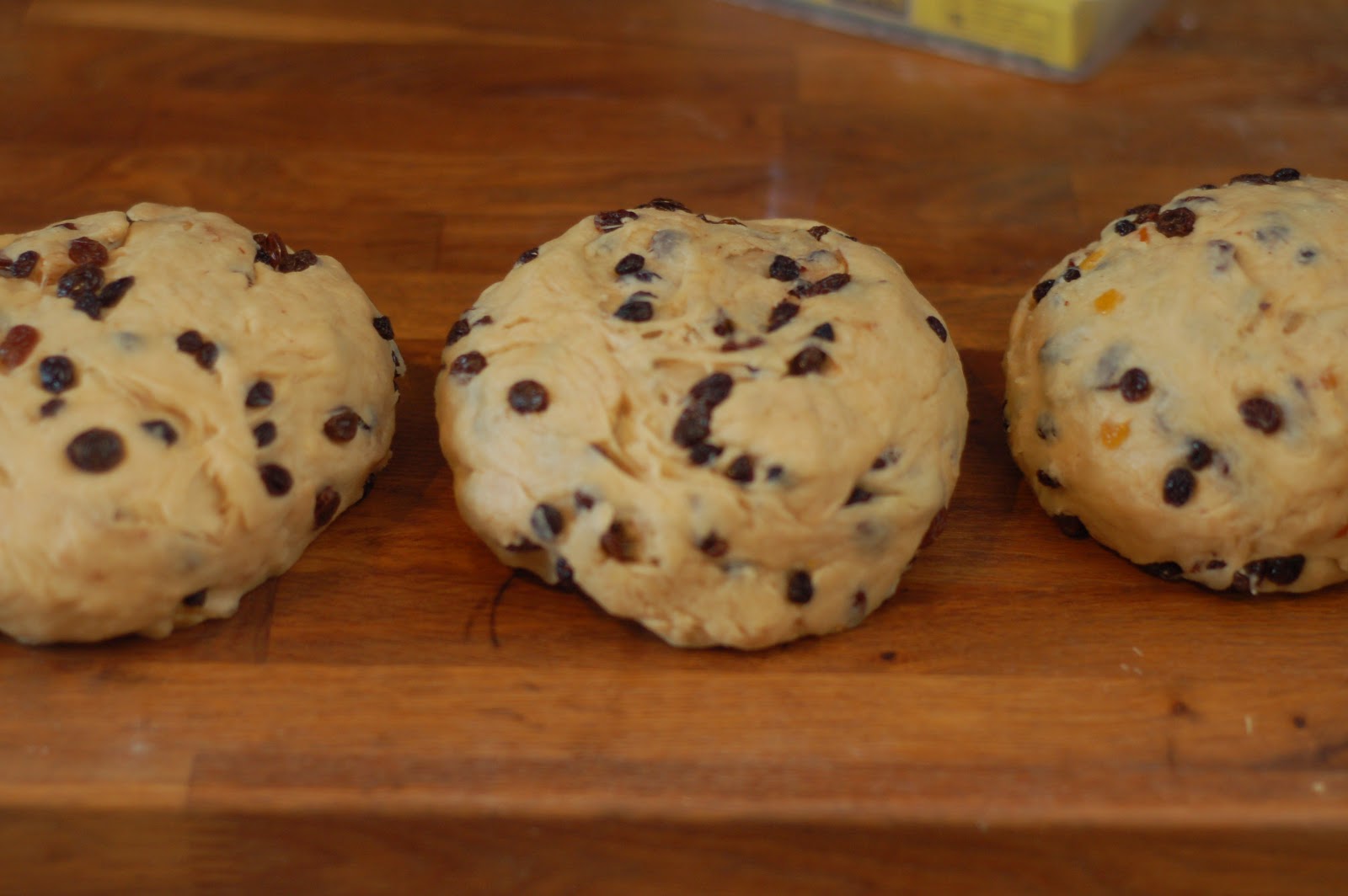
  8. Divide the dough into the number of stollen you want to make then place in to separate buttered bowls, cover with cling film then leave to rise in a warm place for around 3 hours or until tripled in size.


STAGE 2
  1. Punch down the dough, knead for a couple of minutes then cover and leave it to rise for another 30-50 minutes.
  2. Once the dough has risen again, form each one into a rough circle and add 1/3 (or equivalent proportion for the number of loaves you're making) of the marzipan filling in a line through the centre. Fold the edges of the dough over the marzipan so that it is fully enclosed. Place on a greased baking sheet, cover and allow to rise for another hour or more.
  3. Bake in the oven at 180C for about 45-55 minutes until brown.
  4. Once cooked, remove from the oven, brush with melted butter then cover generously with icing sugar and pat on to the loaf to form a solid coating and to seal them.


makowiec (polish poppy seed roll)


Makowiec is a wonderful example of a festive enriched bread that is central to the Christmas celebrations in Poland. It is related to stollen and other similar enriched Christmas breads but the poppy seed filling gives it an entirely different, more complex flavour. My version is based on this one from the Polish language food blog Moje Wypieki. If you find stollen too sweet and you're not a fan of dried fruits I urge you to give this recipe a go. Although it contains raisins and mixed peel they are blended into the filling and treated more as a flavouring.

These quantities are enough to give you three decent sized poppy seed rolls but you can adjust to your requirements. I think if you're going to all this effort to make the makowiec in the first place you may as well go all out and make the full amount and either freeze the spares or give them away to friends and family as gifts. Why not spread the love?


Ingredients
Filling:
450g poppy seeds
170g caster sugar
40g unsalted butter
1 egg
4 tbsp honey
50g mixed peel
grated zest of 1 lemon
30g walnuts
30g almonds
90g raisins
2 egg whites (keep the yolks to one side, they get used in the dough)

Dough:
1 tbsp fast action yeast
750g plain flour
80g melted butter
2 eggs
2 egg yolks
120ml sour cream
130g icing sugar, sifted to remove any lumps
1 tbsp rum or vodka (I used krupnik a Polish, honey scented vodka liqueur)
1/2 tsp salt
1 tsp vanilla extract
approx 100ml warm water

Glaze:
130g icing sugar
1 tbsp water, lemon juice or rum

STAGE 1- The filling
  1. Put the poppy seeds into a saucepan, cover with water bring to the boil then strain through a fine sieve. Set to one side. (As this is my first time making makowiec I'm not sure how essential this stage is. On a repeat effort I would be tempted to miss it out and see if it made any difference. I'll leave the choice up to you.)
  2. Put the raisins, mixed peel, nuts and lemon zest into a food processor along with the poppy seeds an process until you have a rough paste and there are no longer any large pieces of nut or raisin. You can leave this chunky if you like but I prefer a smoother texture. 
  3. In a large pan, melt the butter then add the poppy seed mixture along with the honey and leave to cook over a low heat for around 10 minutes, stirring occasionally. Then remove from the heat. 
  4. In a bowl beat together the egg whites until stiff. Beat the whole egg into the poppy seed mixture followed by the egg whites.
  5. Set the mixture to one side to cool while you make the dough.


STAGE 2 - The Dough
  1. In a large bowl place the dry ingredients (flour, icing sugar, salt and yeast). In a separate bowl or large jug combine the wet ingredients (eggs, egg yolks, sour cream, melted butter, alcohol and vanilla).
  2. Make a well in the centre of the dry ingredients, pour in the wet mixture and combine together adding additional warm water a tablespoon at a time until all the flour is incorporated and you have a rough dough.
  3. Turn the dough out on to a lightly floured surface and knead for around 10 minutes or so until you have a smooth dough. Place in a bowl, cover with cling film and leave to rest for about an hour so that it doubles in size.


STAGE 3 - Putting it all together
  1. Divide the dough and the mixture into the number of rolls you want to make then follow the remaining stages for each roll.
  2. Take the dough and roll it out into a thin, roughly square shape. Spread the required filling evenly across it leaving a small gap all around, then roll the dough up closing the seam and the ends as tightly as you can. 
  3. Place the roll onto a greased baking sheet, cover then set aside to rise for a further 90 minutes. 
  4. Preheat the oven to 180C then bake for 30-40 minutes or until the exterior is golden brown. Allow to cool then glaze.


follow me

Follow Us